Powered by Guardian.co.ukThis article titled "Which is the world’s most wasteful city?" was written by Ben Adler, for theguardian.com on Thursday 27th October 2016 10.00 UTC

New York City endured another brutal summer this year, and you know what that means: a severe urban heat island effect and the omnipresent stench of rotting garbage. Summer in New York makes one acutely aware of the near-constant presence of waste piling up on pavements waiting to be collected and trucked to an out-of-state landfill.

New York is, in fact, widely reported to be the world’s most wasteful city. Wastefulness in this case means New York uses the most energy (“the equivalent of one oil supertanker every 1.5 days”), disposes of the most trash (33m tonnes per year), and uses the most water. The dubious title comes from a study published last spring in Proceedings of the National Academy of Sciences (PNAS).

While the world’s most wasteful city could well be in the consumption-rich US, New York is an unlikely culprit. If the world’s most wasteful city is American, as it very well may be, it’s probably a sprawling sunbelt metropolis like Houston, Atlanta, Tampa, or Phoenix – all of which rate worse than New York on most environmental metrics but weren’t included in that particular study.

Among global megacities, Mexico City generates the most trash after the New York region: 12m tonnes per year. That’s largely a function of relative wealth: the regions have similar population sizes of just over 20 million and 21 million people respectively, but GDP per capita is three times higher in the US.

The parody rubbish film that went viral in Beirut
But waste is a bigger quality of life problem in Mexico. At least the steaming trash in New York is being put out for the sanitation trucks. In 2011, Mexico City closed its largest dump, causing trash to pile up at illegal dumping sites and be left out on the street, highlighting the absence of a comprehensive policy for urban waste collection, disposal and processing. There are signs of hope, though. A number of recycling initiatives have been launched, including one that allows residents to trade in recyclables for vouchers to purchase fresh fruits and vegetables.

The third biggest waste producer among megacities is Tokyo, which is actually impressively austere. Greater Tokyo has more than 50% more residents than Mexico City, but it produces slightly less rubbish. Japan is very densely populated, and so it lacks the space that the US and China have to throw their garbage in landfills. Instead, they have adopted hyper-aggressive recycling programmes to cut down on waste. Tokyo, which strives to be a zero-waste city, is no exception.

So how can Tokyo be rated the third most wasteful city? This is the tricky thing about measuring wastefulness: waste is a byproduct of consumption, and consumption generally tracks with income. “There are some general rules for consumption levels: as income rises, people just cycle through more consumption patterns in general,” says Alex Kovac, a research analyst at the World Resources Institute, an international environmental research organisation. “The wealthier a place is, the more is wasted and thrown.”

A city’s waste rate, Morton says, roughly follows that of the country it’s in. According to a World Bank study from 2012, the most recent on the subject, New Zealand generated the most garbage, 3.68kg per person every day, among developed countries, followed by Ireland, Norway, Switzerland, and the US. But the data on smaller countries may be failing to account for recycling.

Norway, for example, has high rates of recycling and Oslo, its largest city, has successfully reduced its waste production in recent years. Ireland, on the other hand, has lower recycling rates than in the rest of western Europe. Dublin might be one of the most wasteful cities in Europe, but it is still only a second-tier competitor for world’s most wasteful city, as its greenhouse gas emissions are still only half the rate of the US or Australia.

People walking in the street, Tokyo
Tokyo is densely populated, so doesn’t have the space for landfills. Photograph: Yuya Shino/EPA
The US is the world’s biggest producer of trash in absolute terms, generating 624,700 metric tonnes per day, which is 2.58kg/capita. That’s considerably more than many other rich countries, such as Japan’s 1.71kg/capita, the UK’s 1.79kg and France’s 1.92kg.

According to a 2010 study by the water bottle company Nalgene – which measured self-reported behaviours such as using public transportation, recycling, and conserving electricity – the five most wasteful of the US’s 25 largest cities are Houston, Cleveland, Atlanta, Tampa and Indianapolis, in that order. Nalgene found New York was found to be the third least wasteful, after San Francisco and Seattle. (On the subject of water waste, Phoenix, which is built in a desert, devotes half of its residential water use to irrigate lawns.)

In China, waste is growing twice as fast as the population. As the Globe and Mail notes, China now produces an average of 1.12kg per person per day of residential waste, nearly 10% more than the average in Ontario, even though China’s GDP per capita is more than six times lower. Chinese cities don’t recycle, meaning that their waste output could be cut in half, as it has been in neighbouring Taiwan.

China doesn’t break out its waste data by city, but some Chinese cities with notable refuse problems include Beijing, Guangzhou, and Shenzhen, which have started building trash incinerators to pick up the slack from a shortage of landfill capacity. But burning trash, in turn, just worsens their notoriously dirty air. Guangzhou has also started charging households that exceed 1 litre of rubbish per day.

A garbage collector in Beijing; some Chinese cities have started burning waste which is causing more air pollution.
A garbage collector in Beijing. Some Chinese cities have started burning waste, worsening air pollution. Photograph: Kim Kyung-Hoon/Reuters
Which cities have the worst waste problem also depends on how they dispose of it. Most wasteful as measured by total garbage created, will knock out almost all developing world cities, for the simple reason that they cannot afford to buy and waste as much. But if you’re talking about some of the local problems associated with trash, like having it piling up in your streets, some of the world’s poorest cities, such as Manila and Port-au-Prince, have very big problems indeed.

Without the infrastructure to collect garbage, it’s dumped in rivers, canals and streets, and the result is unsanitary chaos. Other developing cities that are overburdened with trash they cannot process include those with fast-growing economies such as Bangalore and Delhi.

Mumbai produces the fifth most waste of any megacity, and last year Bloomberg reported it was “being buried under a mountain of its own trash”. The city of over 18 million people produces 11,000 metric tonnes of trash per day. Plastic wrappers and bottles fill the gutters, backyard waste burning contributes to air pollution, and the rest winds up in a giant open landfill.

In Delhi, which experienced a 50% increase in waste between 2007 and 2012, the lack of formal trash pick-up systems leads to rubbish mountains and impoverished waste pickers sorting through it for anything that can be reused or resold. Delhi’s garbage problem and its overwhelming smog could certainly make it the world’s dirtiest city.

Indian scavengers look for coins and re-usable items amongst the religious offerings and wooden frames of idols of goddess Durga which are piled up in the Yamuna river in New Delh.
Men scavenge for coins and re-usable items in the Yamuna river in New Delhi, India. Photograph: Prakash Singh/AFP/Getty
Rapid population growth itself may also be a risk factor. Jakarta, for example, is one of the world’s fastest growing cities and many of its residents are in the habit of dumping their household items in the nearest waterway. So much makes its way out to sea that 100 tonnes of garbage a day is collected on the beaches of an island five miles away.

Even a rich city can find it impossible to stash away all its waste if it’s too tightly packed. Hong Kong is on the precipice of running out of space in its landfills. A decade ago, Singapore had the same problem, but it implemented policies to boost recycling and burn trash for energy. Now it puts only 2% of its waste in landfills. That’s not without its own drawback: burning rubbish creates air pollution, from carbon emissions to toxins and particulates.

Cairo’s trash problem is unique: not only does it produce 625 kg per person per year of solid waste – a very high rate for a poorer country – but its system of trash pickers, and feeding waste to pigs, have been disrupted by political instability, religious disapproval of pigs by the temporary Muslim Brotherhood government and an outbreak of swine flu.

Whichever of these cities is truly the world’s most wasteful, New York probably doesn’t take the crown after all. The 2015 study titling it thus misleadingly measured its metropolitan region, rather than the city itself. New York City’s metro region includes large swathes of suburbia and satellite cities spread across three states. What’s more, the study only took into account megacities over 10 million people, leaving out a whole host of incredibly wasteful smaller cities.

Throughout the United States, suburbanites have much larger carbon footprints than those who live in the centre of a city. That discrepancy is very pronounced in New York, thanks to the city’s unusually high share of non-drivers and relatively small homes. New York City also has aggressive recycling programmes that are currently expanding beyond paper, metals, and plastics to compost food waste.

The greater density, more pedestrian-oriented urban planning, and vastly superior mass transit networks in Europe and Japan make their cities and suburban towns much more energy efficient than most of the US. Waste charging schemes like “pay as you throw”, food waste projects, widespread recycling, ultimately policies committing to zero waste, are just some of the ways in which cities can become a lot less wasteful. That, and cutting consumption.

Follow Guardian Cities on Twitter and Facebook and join the discussion

guardian.co.uk © Guardian News & Media Limited 2010

Published via the Guardian News Feed plugin for WordPress.


His is article titled "Five of the best group holidays for party people" was written by Will Coldwell, for theguardian.com on Thursday 27th October 2016 05.30 UTC

Get sloshed in a chateau


Party holiday company G&T Weekends was founded in 2014 after friends Gillian Scatliff and Tess Stokes (G and T - geddit?)organised a 60-person break for pals in the Peak District. Now they run all-inclusive party weekends in fancy houses around the world: next up are a New Year’s break in an Icelandic lodge and an Easter adventure in a Moroccan villa The holidays are pitched at those “in limbo between the hard partying years of your early 20s and the serious couples trips of your late 30s”. It’s like booking a holiday home with a big group of (rather well-off) mates but not knowing who’s going to be there – which is obviously a risk. Cue: lots of drinking.

I was invited to join them for three nights at a chateau in the Loire Valley with marble staircase and several floors of honeymoon-style suites with four-poster beds, as well as a library, huge dining room and turrets. It was a beautiful, tranquil, rural retreat, punctuated every so often by a six-foot-something bloke sprinting across the lawn towards the back entrance of the house and bellowing: “We need more rosé!”

The drill for each weekend is relatively similar: big-group catered meals (these were actually pretty great), parties each evening and activities in the day, with plenty of free time to explore the area, or go for a walk with a bottle of champagne, or just sit down and drink a bottle of champagne – it’s your holiday, after all. On my weekend, activities included horse riding and French cooking. Because of its roots as an extension of its founders’ social scene (they’re from Canada and Australia) the bulk of the guests that weekend were expats.

G&T Weekend - large group outside chateau in the Loire Valley
The weekend took place in a chateau in the Loire Valley
It was a formidably boozy weekend - did I mention that already?The free, limitless bar proved too much to resist for pretty much everyone, myself included, especially the girl who tripped backwards into the fountain. With so much drama in such a fanciful, filmic setting, the weekend felt like being in a glossy Hollywood rom-com – somewhere between Meet the Parents and the Wedding Crashers. The guy with an unquenchable thirst for rosé even looked like Vince Vaughn ...

Best for: people who like good food, lots and lots of drink and have a twang to their accent.

OTHER PARTY HOLIDAYS


Ski party, French Alps


Le Paradis club, Morzine
From airstream caravans at Croatian music festivals to party villas in Ibiza, Rude Leisure Group has upbeat accommodation in Europe covered. The company began running ski chalets in Morzine, and for those looking for a house party atmosphere on the slopes, the Rude Lodge is a safe bet. With room for 37 people, the budget B&B was previously owned by one Madame Laury, a dancer at the Moulin Rouge, who had a reputation for running legendary parties at the lodge.

Her spirit has been kept alive in its latest incarnation: Le Paradis club - a popular and “wild” nightlife spot for locals and visitors - is beneath the lodge, sp guests definitely won’t need to worry about the walk home. It has a range of twin and dorm rooms, all en-suite, and a cafe and bar serving snacks and drinks, and aterrace overlooking the town’s river which is ideal for après ski. As for skiing (this is, after all, the main reason to come here), the Super Morzine lift is just 600 metres away.

Best for: late-night ski junkies who think hitting the slopes is the best cure for a hangover.

Christmas and New Year in India


Castle Bijaipur, Rajasthan
Spend Christmas Day at the luxurious Castle Bijaipur, Rajasthan
As festive getaways go, a two-week trip to India is a pretty epic one. But if you have the cash to buy your way out of the stress and miserable weather of the holiday period, Wild Frontiers has the tour for you. Its Alternative Christmas in India is a small-group tour through Rajasthan’s best-known sites, followed by five days at the luxurious Castle Bijaipur, where guests can enjoy yoga, horse riding and, on Christmas Day, poolside champagne. On New Year’s Eve, entertainment by snake charmers and fire eaters will spice up the cocktails.

Best for: sociable culture vultures who want to share a toast with others escaping a family Christmas.
  • Departs 19 December, £2,075pp (£3,000 including flights from London) for 15 days full-board (optional single supplement £495),wildfrontierstravel.com

Boat party, Croatia


Sail Week Croatia
Want a taste of life on a yacht? Sail Week Croatia explores the Dalmatia coast, with a personal skipper sailing the boat from island to island and – perhaps more importantly – party to party. Book just a bed on a boat sleeping 8-10, or book the entire yacht for a group of friends. Depending on the departure date, up to 10 boatloads of revellers set sail together, stopping at the same spots for parties and at clubs each night. The company says guests should consider their yacht a “floating hotel” for a week of “Party. Sail. Repeat”.

Best for: anyone looking for fun in the sun (and those who don’t get seasick).

Bus to festivals in Europe


Benicassim festival in Spain.
Benicassim festival in Spain. Photograph: Alamy
If you want to roll into one of Europe’s biggest festivals with a big group of partygoers, Busabout, which specialises in driving backpackers around the continent, has it covered. The company runs a lively hop-on-hop-off bus service which gives independent travellers cheap, flexible travel between 46 of Europe’s most popular destinations. Trips can then be customised with various festival packages, which Busabout also organises. It’s possible to book just for one festival, such as Hungary’s huge Sziget festival or Benicassim in Spain, so revellers can party – and explore the surrounding area – with a crew of new companions.

Best for: backpacking revellers looking for budget fun.
  • Sziget package from £379pp including festival pass and three nights’ accommodation, Benicassim package from £259pp including festival pass and four nights’ accommodation. Busabout hop-on-hop-off ticket from £285, busabout.com


guardian.co.uk © Guardian News & Media Limited 2010

Published via the Guardian News Feed plugin for WordPress.


Powered by Guardian.co.ukThis article titled "10 of the best holidays for solo travellers" was written by Will Coldwell, for The Guardian on Monday 24th October 2016 10.28 UTC

Prices are per person and do not include flights unless stated

Eternal India


Contiki specialises in holidays for 18 to 35-year-olds and is a popular choice for solo travellers: last year 60% of its guests travelled solo and that figure is set to rise this year. Though it has been running trips around the world for more than four decades, India represents a brand new destination for the company, which is launching tours there this December. The 12-day tour ticks off India’s most popular historical and cultural destinations – Delhi, Agra, Jaipur, Mumbai – as well as heading south for some beach time in Goa. There are also opportunities to customise your trip, with added experiences such as safaris, cooking classes and yoga.
From £1,383 for a same-gender twin-share room, including guides, tour manager, breakfast, one lunch and dinner, all activties, contiki.com

A China experience


China, Mu Tian Yu, The Great Wall of China, overview of meandering wall from above
Trips to Asia have proved popular for solo travellers booking through Wendy Wu, especially among older female travellers. The company offers a range of trips to China – including an epic 28-day trip dubbed “The Big One” – but those looking for a shorter holiday to fit into their schedule might prefer the 10-day “A China Experience”. The tour covers the best known sights, such as the Great Wall and the Terracotta Warriors, but also makes time for less-visited locations, like the peaceful water town Zhujiajiao. Travellers who want to save on the single supplement and are happy to double up in a twin room can opt for the “willing to share policy” – even if there isn’t another traveller to match you with, you won’t be charged any extra.
10 days from £1,890 (single room £280 extra) all-inclusive, including flights, wendywutours.co.uk

Sailing in Croatia and Montenegro


Yacht on Bay of Kotor
Another travel company active in the solo traveller market is G Adventures, which also offers the chance to share rooms to save on the single supplement. Solo travellers account for around a third of those who book. One of its new trips this year is a sailing adventure along the Dalmatian coast, a destination that is growing in popularity with solo travellers. Starting and ending in Dubrovnik, Croatia, the nine-day tour heads south to Montenegro and takes in the dramatic Balkan landscape, beautiful beaches and an old fishing village.
From £869, (allow an additional $250-$325 for meals and $80 for a kitty), gadventures.com

Skiing in Morzine, France


France, Haute Savoie, Morzine
For those looking to get a bit more pumped on their travels, the small independent travel company Hofnar specialises in sociable holidays for single travellers looking for an upbeat chalet experience in the Alps. The company runs a chalet in Morzine and 80% of its guests go solo, meaning they can expect a crowd of like-minded people to hit the slopes with and, well, make the most of the après ski. Trips never have more than 14 people and the laid-back approach means travellers are welcome to do as much or as little as they like during their stay.
Seven nights from £315 (based on a triple share), including breakfast, four dinners, snacks, unlimited soft drinks, host, hofnar.com

West Africa, from Ghana to Togo and Benin


21 day trip across West Africa with Dragoman
Overland travel specialist Dragoman estimates 60% of its clients are solo travellers. It runs small group adventures, with numbers limited to 22 – large enough to have a nice mix and small enough for people to get to know everyone else during their trip. It’s a good option for those keen to go off the beaten track but would prefer not to travel completely independently. One standout is its 21-day trip across West Africa. Starting in Accra, capital of Ghana, travellers are driven east to the forests and hills of Togo’s Mont Klouto before continuing on to Benin – a trip that will involve some difficult roads and some very special wild camps.
From £1,195, plus $440 kitty, including some tours, and food when camping, dragoman.com

Cafe Colombia


Farmer collecting coffee beans at a farm, Colombia
More than half of the travellers who book with Intrepid go alone, so travellers are unlikely to find themselves surrounded by couples and groups. But that hasn’t stopped Intrepid pulling together a trio of solo-only departures for three of its most popular trips. One is a coffee lovers’ dream holiday, heading into the Colombian highlands to visit plantations and roasteries, while staying on a traditional coffee estancia, before heading to Medellin – one of the most exciting cities in South America – and the Unesco world heritage city of Cartagena.
From £1,240, including breakfast plus some meals, transport, some tours, intrepidtravel.com

Yoga retreat in Spain


Suryalila yoga retreat in Spain with Destination Yoga
For a me-time break, a yoga retreat is an obvious option. At Suryalila, in the Andalucian countryside, you’ll be able to stretch those limbs surrounded by beautiful mountains, lakes and fields, and feast on organic vegetarian meals in between twice daily yoga classes. Destination Yoga is a popular choice with solo travellers – 70% of its clients go alone – and the company will also help to match guests with other solo travellers if they want to share a room and keep the price down. If you’re after a healthy way to see in the New Year, join the 28 December trip (returns 2 January).
Five nights from £650, including all vegetarian meals and yoga, destinationyoga.co.uk

Atlas descent, Morocco


Cyclist en route to Telouet, Ounila Valley, Morocco
The team that created this cycle adventure through the incredible scenery of Morocco has explored every trail in the Anti Atlas mountains to chart the best route; so expect a varied ride through palm groves and valleys, enjoying Berber hospitality along the way. This is one of the trips that Exodus schedules with solo travellers specifically in mind, so most other people on the trip will also be travelling alone.
Eight days from £959 including flights, tour leader, most meals, all activities and transport, exodus.co.uk

Japan unmasked


Tokyo. Japan Unmasked trip with Responsible Travel
Responsible Travel runs lots of great small group holidays that make it easy for solo travellers to bond, but one standout trip has to be its two-week tour of Japan. The excellent-value trip has no single supplement, and for more than half of its duration travellers enjoy their own single room (guests share with one other person when staying at traditional inns and smaller accommodations). The trip takes in the highlights of the country, from gleaming cities to Buddhist temples and traditional mountain towns, finishing in Tokyo for a big night out.
From £1,750, including breakfast, some activities, tour guide, one dinner, responsibletravel.com

Mekong delta, islands and temples


A woman walks past a row of repaired old Vespa scooters displayed for sale along a street in Ho Chi Minh
Wild Frontiers offers room shares for solo travellers who would prefer not to pay a single supplement (more than 70% of those on its group tours travel alone). For those keen to jet off for some “me time” over New Year, the company’s impressive 15-day adventure to Vietnam and Cambodia departing 29 December includes touring Ho Chi Minh City on a Vespa, exploring the Mekong Delta by bicycle and wandering among the temples of Angkor. Accommodation will be in boutique hotels and guesthouses throughout the holiday.
From £2,995, including most meals, tour guide, entrance fees, all transport, wildfrontierstravel.com

guardian.co.uk © Guardian News & Media Limited 2010

Published via the Guardian News Feed plugin for WordPress.


Powered by Guardian.co.ukThis article titled "Searching for signs of the Soviets in St Petersburg" was written by Harriet Green, for The Guardian on Saturday 22nd October 2016 09.00 UTC

From the counter, where a woman is pouring buckets of tea into an urn, the queue snakes as far as the front door and out into the street: students, businessmen, women in Prada – and one very elderly, bent lady clutching a paper bag and munching doughnuts. Welcome to the Pyshki cafe, purveyor of greasy Soviet-era doughnuts, treacly tea and service most definitely without a smile since 1953.

How the place has survived is anybody’s guess. Pyshki is on Bolshaya Konyushennaya street, one of the most fashionable in St Petersburg, home to Dior, Louis Vuitton and Prada. Virtually next door is DLT, once the First State Department Store, now the city’s answer to Harvey Nichols, stuffed with designer labels. “Milan prices,” boasts the sign on the door, hinting at the effect of international sanctions imposed since the start of Russia’s conflict with Ukraine.

The Pyshki cafe, St Petersburg
The Pyshki cafe. Photograph: Harriet Green for the Guardian
I’ve come to St Petersburg curious to see what Russians themselves think of the revolution that started in this great city a century ago next year. Do they think of it at all – or is it just something best forgotten?

We have a guide (not compulsory to have one, but helpful, as many sites cater poorly for English speakers). Elena has brought us to Pyshki for a short break from sightseeing. She reddens with embarrassment as the woman at the counter sloshes tea cheerlessly into our polystyrene cups, and tells us her mother adores the place because it reminds her of her childhood. For many older people, Elena elaborates, the Soviet days seem a simpler time – if choice and opportunity were limited, at least people didn’t worry so much about money. They knew where they stood. For people like Elena’s mother, these doughnuts – still warm from the fryer – are so much more than pastries.

Peter and Paul Fortress pictured from across the Neva river.
Peter and Paul Fortress pictured from across the Neva river. Photograph: Getty Images/iStockphoto
Unlike Elena’s mother, young Russians see the anniversary as largely irrelevant, to be remembered only with a kind of kitsch nostalgia, if at all. At the Museum of Soviet Arcade Games, clunky vintage slot machines, using real Soviet kopeks, are played by Russian teens for whom even the fall of the Berlin Wall is ancient history. I look at them and reflect that even their parents were young when my hotel, the historic Angleterre, was pulled down in 1987 (and later rebuilt), leading to the first mass demonstration in the Soviet era to go unpunished.

A room at the Hermitage Museum.
A room at the Hermitage Museum. Photograph: Getty Images/Gallo Images
The tourist trail in St Petersburg is all about the tsars – the palaces of Peter and Catherine the Greats, the French architecture, Renaissance masterpieces, Fabergé eggs, the gold, the jewels. Less visited is a tiny wooden cabin on the banks of the Neva built for Peter in just three days in 1703. Here he lived for six years, on mosquito-infested marshland, while presiding over the building of the city from nothing – a coastal city that would give Russia vital access to Europe. The hut was not much loved by the tsarina, who also had to live in it, but it is one of the most memorable city sites. It’s tiny – just three rooms – and breathtakingly modest. Lacking access to stone, Peter had his workers paint the wooden exterior to look like brick, with horizontal rows of white separated by thin strips of red paint. In 1723, he had it encased in a red brick pavilion, and ordered that it be preserved for posterity, with many of his possessions, including an armchair he carved himself.

The Winter Palace and Hermitage Museum.
The Winter Palace and Hermitage Museum. Photograph: Walter Bibikow/Getty Images
Nearby, at the Peter and Paul Fortress, the bones of the last tsar, Nicholas II, his wife Alexandra and their children were solemnly reburied in 1998 – in a service attended by members of the wider Romanov family. Our guide Elena is solemn when she points out the tombs – covered daily in fresh flowers – and describes their final bleak days in Ekaterinburg, where the family were killed by a Bolshevik firing squad. No one mentions that the Peter and Paul Fortress was where Leon Trotsky was incarcerated in 1905 – as was Lenin’s brother in 1887, after the attempted assassination of Alexander III.

Tsars in their eyes … tourists flock around the Peacock Clock in the Hermitage Museum.
Tsars in their eyes … tourists flock around the Peacock Clock in the Hermitage Museum. Photograph: Alamy
At the tsars’ former Winter Palace, the vast eau-de-nil wedding cake on the banks of the Neva better-known as the Hermitage Museum, we skip from one gold and crystal room to another, gasping at the magnificent vulgarity. The splendour, the 18th-century bling, is almost overwhelming. (The BBC’s recent adaptation of War and Peace on the BBC gave some idea – and triggered a marked increase in British tourists.) In one room, everybody crowds round to gawp at a stunning golden Peacock Clock – fashioned by English jeweller James Cox and acquired for Catherine in 1781. Amid all this ornament there are incredible works: two Leonardos (both Madonnas) as good as any at the Louvre, and numerous Rembrandts, displayed in galleries where the alarms go off every few seconds, as one tourist after another gets too close.

We ask to see the rooms in the palace that were used by the provisional government – the mainstream politicians who held power from February to October 1917, after Nicholas II’s abdication. Elena whips us through chamber after almost deserted chamber of French classical paintings – to a small dining room. This is where the provisional government held its last meeting: on the mantelpiece, the clock is stopped at 2.10am – the moment the Winter Palace was taken by the Bolsheviks. The cruiser Aurora – docked nearby on the Neva – had fired a blank shot to signal the storming of the palace. The government quickly surrendered.

The Museum of Soviet Arcade Games, in St Petersburg
The Museum of Soviet Arcade Games, in St Petersburg. Photograph: Harriet Green for the Guardian
The next day, we visit the Aurora, where an expert explains animatedly how the events unfolded. There are pictures of sailors with red armbands raised high, gleaming shells and other weaponry from a century ago. The cruiser has recently been refitted, but as we are leaving, our guide says there was debate about whether to bother with any of the displays relating to the revolution. More interesting to most Russians are the Aurora’s exploits during the second world war.

As this suggests, the Soviet era is not suppressed in St Petersburg, but you could easily miss it. Here and there we see little hints: the odd plaque on a side street, commemorating where Lenin held some meeting or other. But what happens if you go looking for more? I do that at the Political Museum – once the home of Mathilde Kschessinska, a prima ballerina with the Imperial Ballet. Unquestionably talented, Kschessinska nevertheless owed much of her renown and wealth to her affairs with no fewer than three grand dukes of the Romanov family, including the future Nicholas II. This made her something of a target for the Bolsheviks: she lost her palace to Lenin and friends in April 1917, soon after Lenin returned to Russia.

The armoured cruiser Aurora.
The cruiser Aurora remains a revolutionary symbol. Photograph: Alamy
Lenin’s desk has been preserved in the room that served as the office of the Communist party newspaper, Pravda. And he often made speeches from the nearby balcony, overlooking Kronverkskiy Prospekt. There’s much else here to absorb a keen historian – quantities of material relating to later leaders, notably Stalin – but this is one of several museums that seem not to expect visitors who aren’t Russian, or can’t read or speak the language.

The no-frills Russian Museum is likewise in a vast palace, but reeks of Soviet-era austerity. The grand façade is no less imposing than the British Museum’s in London: there are giant gates bearing imperial eagles. But to get in, visitors creep through a furtive, subterranean side-entrance. The interior is spartan.

House of Soviets and Vladimir Lenin statue at Moskovsky Square.
House of Soviets and Vladimir Lenin statue at Moskovsky Square. Photograph: Feifei Cui-Paoluzzo/Getty Images
This museum attracts far fewer overseas visitors than the Hermitage, which is a terrible shame, because it’s packed with art treasures depicting Russia from before the revolution, through the second world war and beyond the end of the Soviet era.

Works by Ilya Repin (1844-1930) – master social documentarist – hint at the shifts to come. In one room there’s his giant painting of the state council, finished in 1903 – the uniformed establishment soon to be overthrown. His Barge Haulers on the Volga brutally presents the miserable serfs, exhaustedly dragging a boat upstream. Further on, there’s a noticeable shift in 1917 and through the 1920s and beyond, as painters turned their attention from aristocracy to farmers and bus conductors.

Stepping outside the Russian Museum, I find early autumn sunshine sparkling on the city’s brightly painted buildings and busy waterways. It’s easy, for a moment, to think I’m in another European city with canals: Amsterdam or Venice. And St Petersburg is, of all Russian cities, the most European. For most of the time since it was founded, it was Russia’s capital, and even after the government was moved to Moscow in 1918, St Petersburg remained important. Like any former or current capital, it holds much that is beautiful, and much that is darker. Often there are both qualities in the same place.

The Moyka River embankment in St Petersburg
‘It’s easy, for a moment, to think I’m in another European city with canals: Amsterdam or Venice.’ Photograph: Alamy
Take the General Staff Building, a wing of the Hermitage, which rivals Tate Modern in London in its minimalist splendour. It has a breathtaking collection of impressionist and post-impressionist works: Cézannes, Van Goghs, Monets, Picassos, Toulouse-Lautrecs and Matisses. Many were collected by businessman Sergei Shchukin, to fill his Russian home. In one room he kept 16 of Gauguin’s Tahiti paintings. But the Soviets seized it all – Lenin himself signed the decree to expropriate the works – and Shchukin fled to France. Others, as we know, were not so lucky.

Or consider the Astoria hotel, by St Isaac’s Cathedral. The hotel was built in 1910 and, during the first world war, aristocrats threw extravagant parties in its ballroom. Rasputin came here to visit his married lovers. But in 1917, hand-to-hand fighting between Tsarists and Bolsheviks saw blood shed on the pavement outside and, within a couple of years, the hotel had become a popular bolthole for the revolutionaries – with Lenin taking advantage of its royal suite balconies to deliver yet more of his oratory. Renamed Leningrad in 1924, the city fell under siege in the second world war and the Astoria served as a hospital. But Hitler got word of the hotel’s former splendour and made plans to hold his victory party here – even going so far as to make up his invitations.

The Astoria Hotel has seen its fair share of history; its visitors have included Rasputin and Margaret Thatcher.
The Astoria Hotel has seen its fair share of history; its visitors have included Rasputin and Margaret Thatcher. Photograph: Alamy
Hotel guests enjoying the finest luxury today might have no idea of this backstory. Does that matter? Some might laugh, finding kitsch where others see only horror. For me, it’s been a thrill to discover a beautiful city of great cultural significance, and to have to work hard for my lessons in revolutionary history. Others might be satisfied with less. In which case, I recommend a quick study of the brass plaques on the wall beside the Astoria’s elegant elevators. Without comment, these show the names of its many notable visitors. Among them: Elton John, Margaret Thatcher, Lenin and Rasputin.
The trip was provided by Russia specialist Regent Holidays (020-3131 5562) which has a three-night stay at the Angleterre Hotel from £630pp or at the Hotel Dostoevsky from £480pp, based on two people sharing and including breakfast and flights from the UK. For 2017, Regent Holidays will be offering a seven-day guided tour combining the revolutionary highlights of St Petersburg and Moscow

Don’t miss


Icons of Modern Art: The Shchukin Collection
This collection’s arrival at the Fondation Louis Vuitton in Paris is the first time these extraordinary paintings have been seen outside Russia. The exhibition comprises 130 major pieces – seized by Lenin in 1918 after Sergei Shchukin fled the country – with particular emphasis on Monet, Cézanne, Gauguin, Rousseau, Derain, Matisse and Picasso.
22 October to 20 February 2017

Revolution – New Art for a New World
This fascinating new documentary by Margy Kinmonth remembers the avant-garde art movement that thrived in the early years of the revolution. It tells the stories of artists like Chagall, Kandinsky and Malevich who flourished in the years after 1917, only to be silenced in 1932 by Stalin’s brutal crackdown. The film features paintings banned during the Soviet era and masterpieces that rarely leave Russia.
In UK cinemas on 10 November

guardian.co.uk © Guardian News & Media Limited 2010

Published via the Guardian News Feed plugin for WordPress.


Powered by Guardian.co.ukThis article titled "Foley’s: restaurant review" was written by Jay Rayner, for The Observer on Sunday 23rd October 2016 05.00 UTC

Foley’s, 23 Foley Street, London W1W 6DU (0203 137 1302). Meal for two, including drinks and service: £70-£100

At the start of our meal at Foley’s our waitress fixed us with a big, cheery grin and announced that the restaurant served “beautiful food. You will love it.” Oh dear. If there’s one way to guarantee I’ll hate something, it’s by telling me I’m going to love it. Don’t you dare tell me what to feel before I’ve felt it. Don’t you dare try to force me to have a good time. I don’t do enforced jollity. It is, as we know, always hate that springs most eternal.

As it happens I didn’t hate Foley’s. I could well imagine some people might actually love its food, less a style of cooking than a form of gastronomic bare-knuckle fighting in which the shoutiest ingredient wins. It’s food which can’t spell the word “subtle” let alone express it. The problem is one of accumulation; of different but curiously similar flavours piling up, one atop the other, until they begin to topple. But it took time for me to get there, as it will for you.

Foley’s belongs to Mitz Vora, a former sous chef at Palomar, the Jerusalem-born restaurant over in Soho which has turned counter eating into performance theatre, complete with cooks breaking into song and offering shots to the diners. There may well be an element of that at Foley’s because downstairs in the basement is a Palomar-style open kitchen with a dining counter.

Going wild: charcoal-grilled cauliflour.
Going wild: charcoal-grilled cauliflour. Photograph: Sophia Evans for the Observer
Curiously I didn’t know anything about it until I went for a loo break. I found another dining room full of glossy-haired young people having a fine old time. Clearly the staff took one look at us and decided we were not suitable for the counter. They didn’t even mention its existence. Instead they directed us to the subdued space upstairs, where bass lines thunder and chatter bounces off the brick walls, which were only slightly more distressed than we were.

‘Salty and crisp and compelling’: chicken burnt ends.
‘Salty and crisp and compelling’: chicken burnt ends. Photograph: Sophia Evans for the Observer
At Palomar the food plays fast and loose with the culinary traditions of the Middle East. Hummus and fattoush make a showing. At Foley’s, which takes its name from its London street address, the kitchen plays fast and loose with the culinary traditions of just about everywhere. The menu references India and Japan, China and Greece, Thailand, the Middle East and Indonesia. It’s an over-funded gap year of a menu; the sort that could only really exist in a multi-ethnic city at ease with itself.

The curious thing is that taken dish by dish, it works. Peanut crackers, both crumbly and savoury, come with a lightly spiced tomato sambal, which tastes like ketchup’s filthier cousin; the one who learned to smoke and drink before you did. It’s the first appearance of peanuts. If you like peanuts don’t worry. More will be along later.

A dish called “charcoal grilled chicken burnt ends” references the pork rib tips of American barbecue that always end up a little darker than the rest of the meat. These are nothing of the sort, of course, because the ends of chicken ribs would be like Q-tips. These are skin-on pieces of thigh, drenched in a Korean-style marinade and fired up. They are smoky and dark, salty and crisp and compelling.

‘Full of smoked peanuts’: market salad.
‘Full of smoked peanuts’: market salad. Photograph: Sophia Evans for the Observer
Cauliflower has also had a good time in the flames, before being dumped on a tzatziki bed, smeared with a pungent tomato relish and pelted with smoked peanuts for crunch. The textural contrasts are fun. It feels like the kitchen has ticked off a list that reads: “salty, sweet, sour, crunchy”. Along comes a “market salad” full of sprouted greens, and acidulated cubes of cucumber, sour slices of granny smith apple, butter milk and – oh look! – our old friend smoked peanuts.

‘More bloody peanuts’: sticky beef.
‘More bloody peanuts’: sticky beef. Photograph: Sophia Evans for the Observer
Both of these dishes are striking, but both seem built in exactly the same way. The issue becomes more pronounced with the meat side of the menu. A long-cooked piece of short rib, glazed with something salty and sweet, comes with a Thai-inspired salad of spiralised daikon and cucumber, with crispy shallots and more bloody peanuts. The description of the pork belly dish makes it sound entirely different. It’s “Tamarind BBQ, apple, green papaya, buttermilk, cured red onions”.

This one doesn’t have peanuts. Oh no. Nothing of the sort. It has toasted cashews. So that’s a sweet-salty glazed bit of meat, with a sour-crisp salad and more nuts. I find myself imagining Vora standing back from each dish as it was created and muttering “What this dish needs is nuts!” and then hurling handfuls of them at the plate. Even an octopus dish ends up tasting like the beef and pork dishes. That’s quite an achievement. The hunks of tentacle are slow cooked and charred and served with crisped bits of pork mince, an intense black sesame mayo and their own chilli sauce.

Individually each dish really does deliver a thrilling whack. These are big unashamed flavours, with a serious come-hither pout. They’re also well priced, with most around a tenner or less. Perhaps if I popped in for lunch and had a couple to myself it would be fine. But tasting six in a row starts to feel like being shouted at repeatedly by the kitchen.

‘All bravado’: Fatboy Elvis.
‘All bravado’: Fatboy Elvis. Photograph: Sophia Evans for the Observer
Dessert offers a “Fatboy Elvis” but it’s all bravado. There are little pieces of chocolate chip sponge fizzing with bicarb and – you guessed it – peanut honeycomb. Well of course. There’s also something called “bacon crack”, which sounds like it’s applying to be my drug of choice. It turns out to be bacon-flavoured popping candy and less than addictive. Far better are crisp leaves of honeyed filo with crushed caramelised nuts, under a glorious cloud of cardamom-flavoured cream. They could have called it a deconstructed baklava. I thank them for not doing so.

And all this served by one waitress who keeps begging us to tell her which dish is our favourite, and another who asks if she can “tempt” us to another bottle of sparkling water. I’ll be honest. I’ve had more tempting offers. It’s service which puts the “please make it stop” into solicitous. The dessert menu also includes an invitation to purchase a “six pack for the chefs”. Yup, for £6 you can buy the cooks a beer to drink after work. Really? I thought I was already seeing the cooks right by, y’know, paying for the dishes and the 12.5% service charge. Chalk that one up in the column headed “chutzpah”. Foley’s isn’t a bad restaurant. It isn’t a terrible way to spend your money or your time. Some people might even love it. I just doubt I’ll ever be one of them.

Jay’s news bites


Maray in Liverpool takes a similar global approach to Foley’s, but is a little more successful for corralling the various regional influences within each plate rather than across them. Roasted cauliflower comes with the Levantine flavours of pomegranate and harissa; an Asian-influenced scallop dish comes with chilli, seaweed and soy. They have also just announced the opening of a second Maray in Allerton in the Liverpool suburbs later this year or early in 2017 (maray.co.uk).

■ Here’s some jolly news. Donald Trump’s two golfing resorts in Scotland made an £8.4m loss last year. That was double the loss of the previous year. It couldn’t happen to a nicer chap.

■ Further proof, for anybody who needs it, that those in the media business are diversifying. The company behind Time Out is to open a new food and cultural market in London’s Spitalfields. It will occupy 20,000sqft, have space for 17 restaurants and two bars, as well as a cooking school, and will have seating for 450 people. It should launch late in 2017.

Email Jay at jay.rayner@observer.co.uk or follow him on Twitter @jayrayner1

guardian.co.uk © Guardian News & Media Limited 2010

Published via the Guardian News Feed plugin for WordPress.

Powered by Guardian.co.ukThis article titled "Where is the world's most hi-tech city? (And it's not San Francisco …)" was written by Colin Marshall, for theguardian.com on Wednesday 19th October 2016 06.30 UTC

Before long, Santiago could be a city full of electric vehicles charged by “smart” power grids, many of them driving on highways equipped with traffic-reducing automated variable toll pricing. Perhaps a new arrival to the Chilean capital would go for the chance to found a technology company, incentivised by programmes like the state-backed, foreigner-friendly Start-Up Chile, in “Chilecon Valley”. And perhaps they’ll stay for the capital’s reputation boasting the most advanced public transit system in Latin America.

Or they might opt for Africa instead of South America, to take advantage of the assistance offered by organisations like SmartXchange in Durban. Not only does South Africa’s third largest city now have an increasingly tech-savvy middle class population, it has schools like the Durban University of Technology, whose Urban Futures Centre is even developing technological solutions to the common challenges of drug use, security and policing strategy. If these succeed, Durban, like Santiago, may count itself among the highest-tech cities sooner than the rest of the world could imagine.

An urbanite cannot live by startup incubation alone – only implementing the latest technology within a sound built and social environment can make a city truly hi-tech. Indeed, I kept hearing the same answer from current and former San Franciscans asked to name the best such cities in the world right now: “Not San Francisco.” Yet last year Tech Insider’s ranked the “undeniable epicentre of all things tech, from its gigantic start-up culture to its venture capital scene to its population of designers and programmers,” at the top spot. If San Francisco doesn’t rank among the most hi-tech cities in the world, which city could?

The epicentre of tech lies less in San Francisco proper than in Silicon Valley to the south (Tech Insider’s list conflates the two). It’s the birthplace of the personal computer, now home to Apple, Google, Facebook, Intel and Stanford University, and the cradle of thousands upon thousands of startups. Only in recent years have large numbers of technology companies and their workers based themselves in urban San Francisco instead of the suburban Silicon Valley, and the resulting conflicts between the long-term bohemian population and these wealthy new arrivals have exposed its real, underdeveloped technological state.

Twitter headquarters, San Francisco
San Francisco is home to Twitter’s headquarters, but is Silicon Valley still the world’s tech hub? Photograph: Bloomberg/Getty Images
“Planners in 1996 had no way of predicting the tech boom,” admitted Taylor Huckaby, a representative of San Francisco’s Bay Area Rapid Transit (Bart) agency in March in response to residents’ complaints about the unreliability of the city’s transport infrastructure. They’d grown especially fed up with its commuter rail network, designed and built at enormous expense in the 1960s and 70s, much of which, Huckaby tweeted through Bart’s official feed, “has reached the end of its useful life”.

No matter how much app developing innovation San Francisco attracts – Twitter is headquartered there – the experience it provides San Franciscans remains, for the foreseeable future, decidedly low-tech. Other cities have tried to become startup hubs, offering an environment equally attractive to currently small but potentially huge tech companies.

The very nature of a mature city like San Francisco, with its old buildings and layers of regulation, throws serious obstacles to 21st-century modernisation, but some city builders have addressed that problem by starting afresh and raising a state-of-the-art metropolis from the ground up.

Masdar City – a walled, Norman Foster-designed development in Abu Dhabi – began construction in 2008 at the behest of renewable energy company Masdar. The original $22bn (£18bn) plan envisioned a community of 50,000, its energy and other resource use to be all centrally monitored and adjusted. But the global financial crisis deferred this urban dream, greatly slowing construction, curtailing ambitious plans for a personal rapid transit system, and rendering the stated goal of full carbon neutrality seemingly impossible. Only 5% of the planned smart city in the desert stands today.

Participants of the Start Up Chile programme.
Since Start-up Chile began, $40m have been invested in 1,309 startups. Photograph: Ivan Alvarado/Reuters
A more successful example has appeared eight miles from South Korea’s largest international airport: Songdo International Business District, built over 12 years on 600 hectares of reclaimed waterfront land at a cost of $40bn. It is both the world’s first smart city and largest private development in history. Computers embedded in the streets and structures form a citywide information network used for monitoring and maintenance. A pneumatic waste disposal system, obviating the need for garbage cans and trucks, directs all refuse to an automatic central processing facility underground.

With all its built-in computational power, Songdo aims to go beyond the concept of the high technology smart city to become a technologically “ubiquitous city”. Data sensors continually collect information on the city’s flows of water, energy, and traffic for ongoing optimisation. A partnership between Songdo’s builders and Cisco Systems – the Silicon Valley maker of networking equipment – has so far led to the installation of a “telepresence” system, which enables instant audiovisual communication between residents. It also promises the citizenry of Songdo future domestic niceties such as appliances controllable by smartphones and systems to track the whereabouts of their children.

On a private tour, representatives from developer and majority stakeholder Gale International described Songdo to me as not just a technological project but an “urbanistic” one. It synthesises, they said, the best elements of such classically great metropolises as Paris (wide boulevards), New York (Songdo’s own Central Park occupies nearly 10% of its land area), and Venice (visitors can boat down canals dug for the purpose). But not even they could deny that Songdo, with its often empty public spaces and – apart from a few deliberately traditional-looking restaurants – eerie historical uniformity, has yet to replicate the urban essence of those places.

A man drives a zero polluting car in Santiago
Santiago’s zero polluting car. Photograph: Ivan Alvarado/Reuters
Yet urban essence abounds on the other side of the Sea of Japan. As host of the 2020 Olympics, Tokyo intends to use the occasion to build a model city of the future in the form of a completely hydrogen-powered Olympic Village. It will exist, of course, within a city the rest of the world has long seen as a tech spectacle perpetually on the cutting edge.

But as any longtime resident knows, life in Tokyo, with, for instance, the in-person appointments at bureaucratic branch offices, can feel frustratingly low-tech as often as thrillingly hi-tech.

High technology has permeated life far more deeply elsewhere in Asia, most notably in the city state of Singapore. Its lack of resources, small size and high population density have demanded innovative solutions to age-old logistical and environmental urban problems, and its wealth and top-down government control have made those solutions feasible.

Singapore, which integrates technology and urban planning to a unique degree, pioneered the hi-tech solution to the complications of urban life. Its traffic congestion charging system – the first in the world when implemented in 1975 – now uses a network of cameras, sensors, and GPS devises that foresee and head off jams by adjusting the location and amount of the charge, bringing the government $50m in revenue per year. Street crossers also play a role in this web of technology: senior and disabled citizens, for instance, receive radio frequency identification cards that will keep the crossing lights on for them – along with the free high-speed internet every Singaporean gets.

Though no one can deny Singapore’s technological acumen, its squeaky-clean image and paternalistic style of governance could be off-putting for some. But across the South China Sea over in Hong Kong, the faster-living region possesses equally fast internet. It has long been a part of life in Hong Kong, as has the Octopus, the contactless smart-card system used to pay transport fares when introduced in 1997 – but is now the payment system of choice for almost everything. The city’s increasingly ubiquitous fingerprint scanners allow its citizens easier and more secure passage to and fro.

The Future World exhibit in Singapore
The Future World exhibit was held in Singapore, which has been pioneering hi-tech solutions to the complications in urban life. Photograph: Wallace Woon/EPA
But even some of the less overtly futuristic cities in Europe also stand a chance of emerging as the most hi-tech cities of this century. Barcelona, which has perfected most of the traditional niceties of urban life, and continues to dramatically improve its streets, has more recently outfitted itself with energy-saving lights on the streets, touchscreen information stations, traffic and pollution sensors, and charging points for phones and vehicles alike. In collaboration with Barcelona-based universities, Spanish automaker Seat has got to work converting existing parking facilities into hi-tech, service intensive, transit oriented “microcities”.

But perhaps the most technologically promising European capital is on the other end of the continent: Tallinn, Estonia, the birthplace of Skype. The country plowed all the resources it could into information technology after gaining its independence in 1991, and it shows: signs point to the nearest hotspot where one can tap into the high-speed data services available, well before they made it to the US and the UK. Over a decade ago, Tallinn became the first city to hold elections online, through the same system citizens use to pay their taxes and view all government data pertaining to them. Access to these features of Estonian technological life greatly widened when the country introduced a convenient system of e-Residency in 2014.

For my part, I moved from California to Seoul. Home to such tech intensive conglomerates as Samsung and LG, the capital of South Korea has the most plausible claim to the title of the world’s most hi-tech city, despite the haphazardness of the unprecedented rapid development following its near-total destruction in the Korean War. “What a Londoner notices first is the ways in which the city is more advanced than his own,” historian Perry Anderson wrote 20 years ago, marvelling at this more-first-world-than-the-first-world metropolis that seemingly materialised from nowhere. “One is constantly struck by the intelligence brought to the inconspicuous details of living, as if the routines of urban existence were being freshly invented for the first time.”

South Korea’s comprehensive internet infrastructure already sets speed records, and the government plans to widely implement 5G, the next generation of wireless connections, by the year 2020. And Seoulites can connect wherever they please – not only at the city’s more than 10,000 free Wi-Fi hot spots, but even underground, while riding one of the finest metro systems in the world. Real-time displays keep riders apprised of the location of the next train, and the same goes for buses. Commuters can also stop at one of the station’s “virtual stores” where, simply by snapping a picture of their desired product with their smartphone, they can arrange for its delivery to their home the very same day.

Yet even in Seoul, the integration of the hi-tech into urban life occasionally gets stifled: a 1999 law meant to standardise internet payment systems has forced South Koreans to use increasingly outdated web browsers, and economic protectionism (often under the banner of national security) tends to render international e-commerce sites useless, as well as mapping and ride-share applications. However, the country has announced intentions of clearing up some of these issues by the time of the 2018 Winter Olympics in Pyeongchang.

The fruits of humanity’s now seemingly constant technological revolutions and the living patterns of our urban population currently integrate nowhere better than they do in Seoul. Yet the title of the world’s most hi-tech city could go anywhere in the next decade: to a city about to emerge triumphantly from the developing world, to a historic capital that has turned to the future, to a slick development that has settled into its urban identity … or to some place as yet barely imagined.

Follow Guardian Cities on Twitter and Facebook and join the discussion

guardian.co.uk © Guardian News & Media Limited 2010

Published via the Guardian News Feed plugin for WordPress.


Powered by Guardian.co.ukThis article titled "Visitors to Italy can stay for free by sharing skills and goods" was written by Will Coldwell, for theguardian.com on Wednesday 19th October 2016 05.30 UTC

Travellers who are short of cash (and don’t mind a spot of dishwashing) could bag themselves a free holiday in Italy this winter thanks to an initiative that facilitates bartering between bed and breakfast hosts and their guests.

Running from 14-20 November, La Settimana del Baratto – or Barter Week – encourages travellers to exchange goods and services for a free stay in thousands of Italian B&Bs.

To take part, prospective guests can list what they have to offer on the Barter Week site. Alternatively, guests can browse the wishlist of B&Bs and contact them to negotiate their stay.

The wishlist currently includes a huge range of requests. Some hosts, for example, will let you stay in exchange for quality local produce from your home region or country.

BB San Marco Venezia
B&B San Marco Venezia. Photograph: bbday.it
Others will give you a room in exchange for a live musical performance, while many are bartering for some help with the business – from translating the website or conducting a photo shoot to painting the shutters or doing some gardening.

Barter Week was launched in 2009 by Italian B&B bookings site bed-and-breakfast.it after the team discovered that one of the B&Bs listed on the site used to practise barter instead of normal payments for its business.

In the first year, around 1,000 B&Bs signed up to offer a barter service for one week during low season. Now the number taking part has doubled.

Last year’s Barter Week saw over 10,000 requests and proposals listed on the site. According to data it has collected, the most commonly requested barter from B&B hosts was travel itself – with 25% of owners offering their home in exchange for a stay elsewhere.

After that, B&B owners most commonly asked for home improvement help (19%) or assistance with communication and marketing (15%).

On the traveller side, the most commonly offered barter (37%) was help with communication projects – photo and video, translations or social media. After that, 14% offered to help with housework or repairs and 12% offered lessons in specialist skills, from knitting to belly dancing.

BB Nonna Rana Cannara
B&B Nonna Rana, Cannara. Photograph: bbday.it
This year has already seen some unusual barters take place. Rome B&B A Casa di Lia bartered two nights for a mosaic representing the helmet of Achilles made by an artist from Naples. On its wishlist it also asked also for a trained hawk, whereupon a falconer got in contact with information on falconry lessons.

In Naples, B&B DormidaMè, exchanged hospitality for natural soaps made from waste oil, while the Masseria San Martino in Puglia is hosting a Russian woman who is helping harvest olives.

Although Barter Week fosters a large number of exchanges, some B&Bs accept barters all year round. These can be found on the barattobb.it site, which lists about 1,000 places to stay.

guardian.co.uk © Guardian News & Media Limited 2010

Published via the Guardian News Feed plugin for WordPress.

Powered by Guardian.co.ukThis article titled "A bookworm’s tour of Barcelona’s librerías" was written by Christian House, for The Observer on Sunday 16th October 2016 08.00 UTC


“Every bookshop is an invitation to travel,” observes Jorge Carrión, the Spanish author who has offered me a walking tour of Barcelona’s librerías. Carrión, also a lecturer at Barcelona’s University of Pompeu Fabra, knows all about the pleasures of discovering volumes in far-flung places, from Charing Cross Road to the boulevards of Buenos Aires.

Among its many cultural attractions, Barcelona’s unique and varied bookshops don’t feature heavily on many visitors’ hit lists. Yet they should. There are around 50 spread across the city.

We start by heading west, along the Gran Via de les Corts Catalanes – the longest street in Catalonia. The ones we see have English titles peppering their Catalan and Spanish selections. There are two dedicated English language bookstores which cater to the city’s expat set, although Carrión insists that the real treasures are to be found elsewhere.

Our starting point on Carrer de Bailèn is Gigamesh, a Mecca for sci-fi fans, and Carrión’s childhood haunt. Coming to the city from his hometown of Mataró, he was spoilt for choice. “There were eight bookshops of comics, role games and fantastic science fiction,” he says. “It was a ritual to go on a Saturday morning.” Gigamesh is also a successful publisher; in 2002, it bought the Spanish rights to the Game of Thrones saga.

Around the corner, on the Gran Via, the boutique publisher Jan Martí has recently opened Blackie Books’ Lino. There you can find copies of books by Mark Twain alongside George Perrault’s fairytales, housed in the concierge booth of La Casa Bonay hotel. Its post-siesta opening hours attract the cocktail crowd heading into Libertine, the bar at the end of the tiled passage.

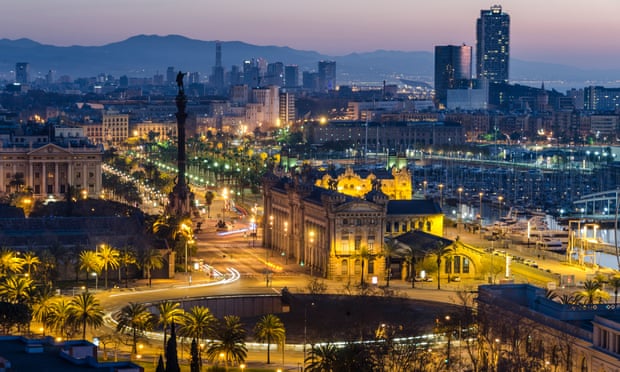
Full of cultural treasures: Barcelona by night.
Full of cultural treasures: Barcelona by night. Photograph: MartiGarcia/Getty Images/iStockphoto
Bookshops in Barcelona haven’t always been allowed to flourish, explains Carrión. “We have a very important network of public libraries. It is like part of democracy,” he says. During Franco’s regime, however, booksellers were at the mercy of censors. “A lot of bookshops had a secret room [containing] the forbidden books by the authors in exile.”

Things changed in the 1980s and now Barcelona is the literary centre of Catalonia. Laie, on Carrer de Pau Claris, is a librería-café which offers international books alongside Catalan dishes. Further along Gran Via, the travel bookshop, Altaïr, matches regional guides to novels set in the area, a format familiar to customers of Daunt Books in London.

As we bypass Plaça Catalunya and the busy Barri Gotic, Carrión explains how Barcelona has become saturated by tourism, a situation exacerbated by the cruise ships with their daytrippers in search of paella and sangria.

Avoiding the throngs, we head instead to an imposing modernist mansion near the Jardins de la Reina Victòria. A creaky cage lift takes us up to the second floor and the elegant Librería Anticuaria Comellas, Carrión’s “secret bookshop”. The selection of rare books, ranging from typography to gastronomy, is impressive and I’m particularly taken by a collection of gruesome volumes on ophthalmology, though less so by the eyewatering €250,000 price tag.

Returning to the heat and traffic, we turn down Carrer de les Ramelleres, past the ramshackle apartment once owned by the Chilean novelist Roberto Bolaño, to La Central – “the best bookshop in Barcelona”, says Carrión. It used to be a maternity hospital and still has a hatch in the wall where abandoned babies were left for the orphanage. The feel is monastic with its vaulted ceilings and wooden floors. Its designer, Miguel Sal, created a similar sense of calm and space in Waterstones, Piccadilly, in London.

We continue through the Plaça dels Angels and around the vast goldfish bowl windows of the Museu d’Art Contemporani de Barcelona to the CCCB cultural centre bookshop, well stocked with the great intellectuals of the region, such as the medieval Majorcan philosopher Ramon Llull.

Llibreria Calders, in Sant Antoni, is in a disused button factory.
Llibreria Calders, in Sant Antoni, is in a disused button factory. Photograph: Josep Lago/AFP/Getty Images
Next is lunch at a café in the 18th-century cloisters close by, a setting that could have come from the pages of Carlos Ruiz Zafón’s The Shadow of the Wind. Carrión rolls his eyes when I mention the gothic novel about a cigar smoke-steeped bookshop in the old town. “Tourism and bestsellers have this mechanism of recognition,” he says. “I’m not interested in recognition, I’m interested in discovering.”

After lunch, we visit Llibreria Calders, in the Sant Antoni neighbourhood. This popular bookshop opened at the height of Spain’s financial crisis, in a disused button factory just off Carrer del Parlament, which Carrión says is “the most hipster street in Barcelona”.

It has a piano bar and a hectic programme of concerts and readings, where customers spill outside to drink under the plane trees. There’s also enough poetry, literary fiction and graphic novels to satisfy any contemporary bibliophile.

Although, notes Carrión, even the most enthusiastic bookworm needs to take stock occasionally. He has recently moved to a new apartment with his wife and children. “I had to give 1,000 books to a friend,” he says. “If you’ve got more than 5,000 books, you’ve lost control.”

guardian.co.uk © Guardian News & Media Limited 2010

Published via the Guardian News Feed plugin for WordPress.
Next PostNewer Posts Previous PostOlder Posts Home